

Published on: 2025-10-09 | Written by: Dr. Hatem Ajur, PhD in Ophthalmology
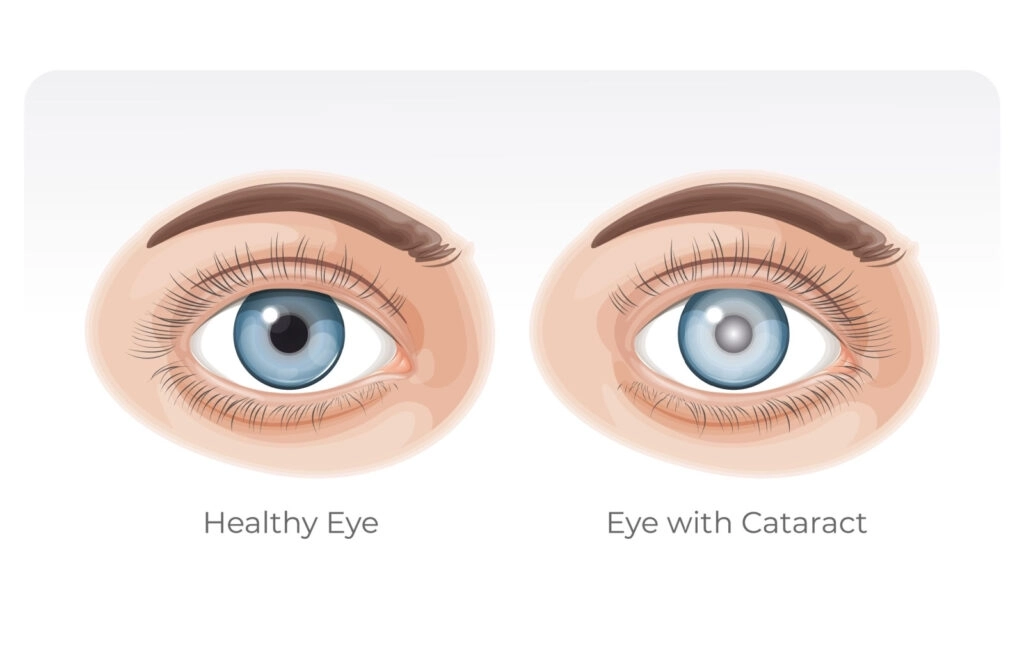
Cataracts are among the most common eye conditions affecting visual clarity and quality of life. They occur when the natural lens of the eye becomes cloudy, leading to blurred vision and difficulty seeing clearly, especially when driving at night, reading, or dealing with bright lights. With advances in ophthalmology, cataract surgery has become more precise, using modern techniques to remove the cloudy lens and restore clear vision according to each patient’s condition.
Professor Major General Dr. Hatem Abdel Halim Agour, Consultant in Ophthalmology, Vision Correction, and Eyelid Cosmetic Surgery, provides specialized cataract surgery services using ultrasonic technology according to the Japanese AKAHOSHE technique, in addition to his experience in eye surgery and vision correction.
What Are Cataracts?
A cataract is a condition in which the natural lens of the eye gradually loses its transparency. The lens becomes less capable of transmitting light normally to the retina, affecting the clarity of the images the patient sees. Although cataracts are commonly associated with aging, they may also develop due to other causes, such as eye injuries, certain chronic diseases, or prolonged use of some medications, depending on the physician’s assessment.
Understanding the nature and symptoms of cataracts helps with early detection, particularly when the condition begins to affect daily activities such as reading, watching television, recognizing faces, or driving.
What Are the Symptoms of Cataracts?
The most common symptoms of cataracts include:
Blurred vision and difficulty seeing details clearly.
Colors appearing less vivid or more faded.
Difficulty seeing in dim lighting.
Increased sensitivity to light and glare.
Seeing halos around lights, especially at night.
Difficulty driving at night because of headlights from oncoming vehicles.
Frequent changes in eyeglass prescriptions.
Difficulty reading or using a phone for extended periods.
Gradual deterioration in visual acuity despite wearing prescription glasses.
When these symptoms appear, a comprehensive eye examination is recommended to determine the cause, as blurred vision may also result from other conditions affecting the cornea, retina, or optic nerve.
What Causes Cataracts?
Several factors may contribute to the development of cataracts or increase the likelihood of developing them. Aging is one of the most common causes.
The main causes and risk factors include:
Aging: Proteins in the natural lens gradually change over the years, which may cause the lens to lose its transparency.
Diabetes: High blood sugar levels may be associated with an increased risk of cataracts or faster progression.
Eye injuries: Certain injuries or trauma may cause clouding of the lens.
Genetic factors: Some inherited factors may increase the likelihood of developing cataracts.
Certain medications: Long-term use of some medications, such as corticosteroids, may increase the risk.
Ultraviolet radiation: Repeated exposure without appropriate protection may contribute to changes in the lens.
Congenital cataracts: Some children are born with cloudy lenses or develop cataracts during childhood.
Identifying the possible cause and determining its effect on vision require a specialized examination by an ophthalmologist.
When Does a Patient Need Cataract Surgery?
Not every case of cataracts requires immediate surgery. The decision depends on the degree of clouding, its effect on vision and daily activities, and the physician’s assessment.
In the early stages, adjustments to lighting or a change in eyeglass prescription may temporarily improve vision. However, these measures do not remove the cloudiness in the lens.
Surgery becomes an appropriate option when cataracts interfere with the patient’s ability to perform daily activities, when glasses no longer provide sufficient visual improvement, or when the physician determines that surgery is necessary for reasons related to eye health.
Professor Major General Dr. Hatem Abdel Halim Agour, Consultant in Ophthalmology and Eye Surgery, evaluates the need for surgery according to examination findings, the degree of visual impairment, the condition of the lens, and the health of the other parts of the eye.
How Is Cataract Surgery Performed?
Modern cataract surgery involves removing the natural lens that has become cloudy and replacing it with a clear artificial intraocular lens to help restore visual clarity.
The procedure is usually performed under local anesthesia, depending on the patient’s condition and the physician’s assessment. Surgery is relatively brief in many cases, although the duration varies according to the nature of the condition and the technique used.
The main steps include:
Preoperative eye examination: Assessing the degree of cataract, examining the cornea and retina, and measuring the eye.
Selecting the appropriate artificial lens: Calculating the required lens power based on eye measurements and the intended visual outcome.
Removing the cloudy lens: Using the surgical technique appropriate for the patient’s condition.
Implanting the artificial lens: Placing a clear lens inside the eye to replace the cloudy natural lens.
Postoperative follow-up: Monitoring healing, assessing visual improvement, and checking for potential complications.
The details of the procedure vary from one patient to another. Therefore, a thorough preoperative examination is one of the most important steps toward achieving the best possible outcome.
Cataract Surgery Using Ultrasound Technology
Ultrasound-assisted cataract surgery is widely used in modern cataract treatment. This technique uses a specialized device to break the cloudy lens into small fragments, which are then removed through a small surgical incision. A clear artificial lens is subsequently implanted inside the eye.
Potential benefits of this technique in suitable cases include:
A relatively small surgical incision.
Reduced need for stitches in many cases.
Support for postoperative recovery, depending on the condition of the eye.
The ability to implant a suitable artificial lens inside the eye.
Improved vision following removal of the cloudy lens.
Professor Major General Dr. Hatem Abdel Halim Agour provides cataract surgery using ultrasound technology according to the Japanese AKAHOSHE technique. However, each patient must be evaluated to determine whether this technique is appropriate.
It is important to understand that the final outcome depends on several factors, including the condition of the cornea, retina, and optic nerve, the severity of the cataract, and the presence of other eye conditions.
What Is the Difference Between Laser and Ultrasound Cataract Surgery?
Different technologies are available for performing certain steps of cataract surgery. The choice depends on the patient’s condition, available equipment, and the surgeon’s expertise.
Ultrasound-assisted surgery: Uses a device that applies ultrasound energy to break up and remove the cloudy lens before an artificial lens is implanted.
Femtosecond laser-assisted surgery: Uses laser energy to perform certain steps of the procedure, such as creating precise incisions or assisting with opening the lens capsule. Other steps may still require surgical instruments and additional techniques.
Neither technique is necessarily the best choice for every patient. The decision depends on the eye examination and the individual characteristics of the eye, rather than the name of the technology alone.
An ophthalmologist can determine the appropriate approach after evaluating the cataract, measuring the eye, and identifying any associated conditions.
Types of Artificial Lenses After Cataract Removal
After the cloudy natural lens is removed, an artificial intraocular lens is usually implanted. These lenses differ in their ability to correct refractive errors and in the extent to which patients may need glasses after surgery.
Common types include:
Monofocal lenses: Provide clear focus at a specific distance. Depending on the outcome, patients may need glasses for reading or certain distances.
Multifocal lenses: Designed to help patients see at more than one distance, although they are not suitable for everyone.
Extended-depth-of-focus lenses: Help provide a broader range of vision than some monofocal lenses.
Toric lenses: May be suitable for some patients with astigmatism, depending on eye measurements and the physician’s assessment.
The appropriate lens is selected after precise measurements and a discussion of the patient’s daily visual needs and expectations. The benefits and limitations of each lens type should also be explained.
Is Cataract Surgery Painful?
In most cases, cataract surgery is performed under local anesthesia, so patients generally do not experience significant pain during the procedure. Some may feel mild pressure or discomfort, depending on the anesthesia method and their individual condition.
After surgery, temporary mild burning, a foreign-body sensation, or slight tearing may occur. These symptoms usually improve during recovery.
However, severe or increasing pain, significant redness, or a sudden decline in vision after surgery requires urgent contact with the physician for assessment.
How Long Does Recovery Take After Cataract Surgery?
Recovery varies from person to person, but many patients notice gradual improvement in vision during the first few days after surgery. Vision may take several weeks to stabilize, depending on the condition of the eye, the type of procedure, and the presence of other medical conditions.
To support recovery, patients should follow their medical instructions, including:
Using prescribed eye drops at the specified times.
Avoiding rubbing or pressing on the eye.
Not using any eye drops that have not been medically prescribed.
Attending all scheduled follow-up appointments.
Avoiding water or irritating substances entering the eye according to medical instructions.
Avoiding swimming and strenuous activities until permitted by the physician.
Using an eye shield when necessary and as recommended.
Contacting the physician immediately if severe pain or a sudden decline in vision occurs.
Regular follow-up helps detect potential problems early and monitor visual improvement.
Can Cataracts Return After Surgery?
The cataract that has been removed does not return to the same natural lens because the cloudy lens is removed and replaced with an artificial one.
However, some patients may develop a condition known as posterior capsule opacification, in which the thin membrane behind the artificial lens becomes cloudy. This may cause blurred vision some time after surgery.
If this condition develops, the physician can evaluate it and determine whether treatment with an appropriate laser procedure is needed. This procedure is different from the original cataract surgery.
What Are the Possible Complications of Cataract Surgery?
Cataract surgery is a common procedure, but like any surgery, it carries potential risks. The likelihood of complications varies according to the patient’s condition, eye health, and the surgical circumstances.
Possible complications include:
Eye inflammation or infection.
Increased eye pressure after surgery.
Corneal or retinal swelling.
Problems with the position of the artificial lens.
Retinal detachment in some cases.
Persistent vision problems caused by pre-existing conditions affecting the cornea, retina, or optic nerve.
A thorough preoperative examination, adherence to medical instructions, and regular follow-up help reduce risks and allow complications to be detected early.
Cataracts and Diabetes
People with diabetes may have a higher risk of developing cataracts and may also experience other eye conditions, such as diabetic retinopathy. Therefore, assessing the retina before surgery is important to identify possible causes of reduced vision and establish an appropriate treatment plan.
Important recommendations for patients with diabetes preparing for cataract surgery include:
Monitoring blood sugar levels according to their treatment plan.
Undergoing a retinal examination as recommended by the physician.
Informing the physician about all medications and existing medical conditions.
Following all preoperative instructions.
Continuing follow-up after surgery to monitor eye health.
Visual improvement after cataract removal may be limited if the patient has retinal or optic nerve damage. Therefore, expected outcomes should be discussed before surgery.
The Importance of Choosing a Specialist in Cataract Surgery
The success of cataract surgery depends on several factors, including the accuracy of preoperative examinations, selection of the appropriate technique, calculation of the artificial lens power, performing surgery in a manner suitable for the eye, and postoperative follow-up.
Choosing a specialist in ophthalmology is an important step in evaluating the condition and answering the patient’s questions about the procedure, artificial lens options, recovery period, and expected results.
Professor Major General Dr. Hatem Abdel Halim Agour provides specialized ophthalmology and vision correction services, including cataract surgery using ultrasound technology according to the Japanese AKAHOSHE technique, as well as refractive surgery and eyelid cosmetic surgery.
Professor Major General Dr. Hatem Abdel Halim Agour for Cataract Surgery and Vision Correction
Professor Major General Dr. Hatem Abdel Halim Agour is a Consultant in Ophthalmology, Vision Correction, and Eyelid Cosmetic Surgery. He holds a PhD in Ophthalmology and Eye Surgery from Alexandria University. He previously worked as a Lecturer of Ophthalmology and Eye Surgery at the Military Medical Academy and served as a Consultant and Head of the Ophthalmology Department at the Armed Forces Hospital.
His specialties include cataract surgery using ultrasound technology, vision correction procedures using LASIK, Femto-LASIK, and Femto-SMILE techniques, as well as precise eyelid cosmetic surgery.
His professional background also includes membership in the American Society of Eye Surgery and the European Society of Cataract and Refractive Surgeons.