

Published on: 2026-11-12 | Written by: Dr. Alaa Abdel-Hady El-Saghir, Consultant Urologist
Kidney and ureteral stones are among the most common medical conditions affecting the urinary system. They can cause severe pain in the sides and lower back, difficulty urinating, and blood in the urine in some cases. These stones develop when minerals and salts in the urine accumulate and form crystals, which may gradually grow into stones of different sizes inside the kidneys or ureters.
Treatment options for kidney and ureteral stones vary depending on the stone's size, location, composition, and its effect on urine flow and kidney function. Therefore, accurate diagnosis is an essential step in selecting the appropriate treatment and preventing complications such as ureteral obstruction, urinary tract infections, and impaired kidney function.
Dr. Alaa Abdel Hady El-Saghir, Consultant of Urology, Kidney Surgery, Andrology, and Male Infertility in Alexandria, provides specialized diagnostic and treatment services for kidney and urinary tract conditions, including the assessment of kidney and ureteral stones and determining the most appropriate treatment approach according to each patient's test results and medical condition.
Kidney stones are hard deposits formed from minerals and salts in the urine inside the kidneys. They can vary in size, ranging from tiny crystals that cause no noticeable symptoms to large stones that may obstruct the urinary tract.
Ureteral stones are stones that move from the kidneys into the ureters, the tubes responsible for carrying urine from the kidneys to the bladder.
Ureteral stones may cause severe pain due to obstruction of urine flow and increased pressure within the urinary system. Some cases require medical intervention to remove the stone and restore normal urine flow.
Several factors can increase the likelihood of developing kidney and ureteral stones, including:
Symptoms vary depending on the size and location of the stone and whether it causes urinary obstruction.
Common symptoms include:
When Are Kidney Stones a Medical Emergency?
Immediate emergency medical attention is necessary if severe pain is accompanied by fever or chills, inability to urinate, or persistent vomiting, particularly when urinary obstruction is suspected. An obstructed urinary system accompanied by infection can be a serious medical emergency requiring urgent intervention.
Kidney stones differ according to their chemical composition. The most common types include:
These are among the most common types of kidney stones. They form when calcium combines with oxalate in the urine.
These stones develop when uric acid levels in the urine become elevated or when urine becomes excessively acidic. They may be associated with certain metabolic disorders and gout.
These stones may form as a result of recurrent urinary tract infections caused by bacteria that produce the enzyme urease. They can grow rapidly and sometimes reach considerable sizes.
These are less common stones caused by an inherited disorder that affects the kidneys' ability to reabsorb the amino acid cystine.
Identifying the type of stone helps the doctor select the appropriate treatment and develop an effective prevention plan.
Diagnosing kidney and ureteral stones involves a medical examination, laboratory tests, and imaging investigations. These tests help determine the stone's location, size, degree of obstruction, and potential effect on kidney function.
A urine test helps detect blood, crystals, and signs of infection. A urine culture may also be requested if a bacterial infection is suspected.
Blood tests measuring creatinine and estimated glomerular filtration rate (eGFR) help assess kidney function, particularly in cases involving urinary obstruction or recurrent stones.
Ultrasound imaging helps identify many kidney stones and detect signs of urine accumulation inside the kidneys due to urinary obstruction.
A non-contrast computed tomography (CT) scan is one of the most important investigations used to diagnose urinary stones. It helps determine their size, number, location, and the degree to which they affect urine flow.
When a stone passes naturally or is surgically removed, the doctor may request a chemical analysis to identify its composition and determine the most appropriate preventive measures.
There is no single treatment suitable for every case of kidney or ureteral stones. Treatment selection depends on the stone's size, location, composition, the presence of obstruction or infection, kidney function, and the patient's overall health.
The main treatment options include:
Some small stones can be managed conservatively, particularly when they do not cause significant obstruction or serious complications.
Treatment may include:
The likelihood of spontaneous stone passage depends on its size and location. Medical treatment alone should not be relied upon in cases requiring intervention.
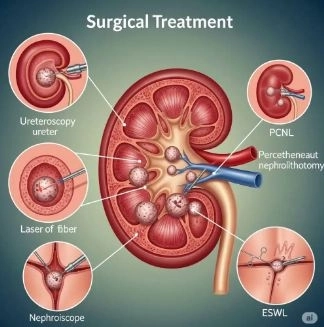
Extracorporeal shock wave lithotripsy is a procedure that uses focused energy waves to break kidney stones into smaller fragments that can pass naturally through the urine.
It is used in selected cases depending on the stone's size, location, and composition. Some patients may require more than one treatment session.
Ureteroscopy is a modern technique used to treat ureteral stones. A thin endoscope is inserted through the urethra and bladder to reach the stone.
The doctor may use laser energy to break the stone into smaller fragments, which can then be removed or allowed to pass naturally, depending on the case.
One of the main advantages of this procedure is that it usually does not require an external surgical incision and allows direct access to the stone.
Flexible ureteroscopy allows the doctor to reach different areas of the kidneys through the urinary tract. Laser energy can then be used to fragment stones located inside the kidneys.
It is an important treatment option for selected kidney stones, particularly those that are difficult to reach using conventional endoscopic techniques.
The suitability of this procedure depends on the stone's size, location, number, and the patient's medical condition.
Percutaneous nephrolithotomy is used to treat certain large or complex kidney stones, particularly stones occupying substantial portions of the kidney.
During the procedure, a small access tract is created through the skin to reach the kidney. An endoscope is then inserted to fragment and remove the stones.
This procedure may be suitable for large or staghorn stones that are not appropriate for other treatment methods.
Yes. Laser technology is used to treat many types of kidney and ureteral stones through specialized endoscopic procedures.
The technique involves inserting a thin endoscope to reach the stone and using laser energy to break it into smaller fragments.
The main advantages of laser stone treatment include:
However, laser treatment is not necessarily the best option for every patient. The appropriate technique depends on the stone's size, location, composition, and the presence of complications.
A surgical or endoscopic intervention may be necessary in the following situations:
In certain cases of urinary obstruction accompanied by infection, the priority is to drain the urinary system and treat the infection urgently. Definitive stone removal is then performed after the patient's condition has stabilized.
Kidney and ureteral stones may affect kidney function if they cause prolonged or recurrent urinary obstruction, particularly when both kidneys are obstructed or when the patient has only one functioning kidney.
Repeated infections associated with stones may also damage kidney tissue in certain cases.
Therefore, stone-related symptoms should never be ignored. Early diagnosis and appropriate treatment are essential to preventing complications.
Healthy lifestyle habits can help reduce the risk of stone formation, particularly in people who have previously experienced kidney stones.
Some patients may also require specialized 24-hour urine testing to identify the underlying causes of stone formation and establish appropriate preventive measures.
Dr. Alaa Abdel Hady El-Saghir is a Consultant of Urology, Kidney Surgery, Andrology, and Male Infertility in Alexandria. He holds the Egyptian Fellowship in Urology and a Master's Degree in Urology and Reproductive Surgery from Alexandria University. He is also a member of the Egyptian and European Urological Associations.
Dr. Alaa Abdel Hady El-Saghir provides diagnostic and treatment services for urinary system conditions, including the assessment of kidney and ureteral stones. This involves evaluating stone size, location, the degree of obstruction, and its potential impact on urine flow and kidney function before determining the appropriate treatment approach.
His areas of practice include:
Kidney and ureteral stones require accurate diagnosis to determine their size, location, and impact on the urinary system, followed by selecting the most appropriate treatment, whether medication, shock wave lithotripsy, laser endoscopy, or surgical intervention.
Never ignoring pain, symptoms of ureteral obstruction, or urinary tract infections is essential to protecting kidney health and preventing complications.
If you experience symptoms of kidney or ureteral stones, consulting Dr. Alaa Abdel Hady El-Saghir, Consultant of Urology, Kidney Surgery, Andrology, and Male Infertility in Alexandria, can help assess your condition and identify suitable treatment options based on an accurate medical diagnosis.