
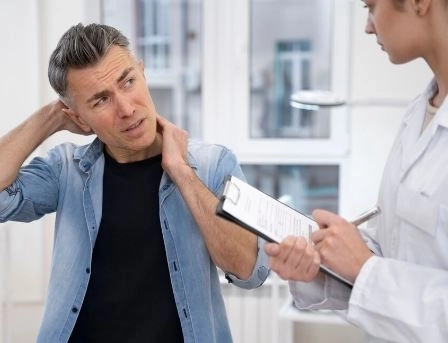
Have you ever felt stiffness in your shoulder or knee joint, or difficulty moving your arm or leg after a period of rest? This could be a sign of joint fibrosis, a common condition that affects the joint’s mobility and sometimes causes chronic pain. Joint fibrosis can result from an injury, chronic inflammation, or even lack of movement. If left untreated, it may eventually lead to a permanent loss of normal joint motion.In this Daleeli Medical article, we will explore the causes of joint fibrosis, its symptoms, diagnostic methods, and different treatment options—including medications, exercises, and surgery. We will also provide important tips to speed up recovery and keep your joints healthy and flexible.
Joint fibrosis is a condition that affects joints after surgery or trauma, such as the knee, shoulder, elbow, or ankle. It results from excessive scar tissue formation inside and around the joint, leading to severe stiffness, pain, and loss of joint function.
It often appears after surgeries such as:
Anterior cruciate ligament (ACL) surgery
Meniscus repair surgery
Other knee surgeries
1️⃣ Can joint fibrosis improve on its own?
In very mild cases, it may improve with regular exercises and consistent joint movement. However, most cases require physical therapy or medications to reduce stiffness and pain.
2️⃣ Is pain always present?
Pain is usually intermittent and worsens with movement or after prolonged rest. In severe cases, pain may be constant and require medication or surgery.
3️⃣ Does every case require surgery?
No. Most cases improve with medications and exercises. Surgery is usually reserved for advanced cases or when joint stiffness severely affects daily life.
4️⃣ Can fibrosis come back after treatment?
Yes, especially if the joint is not exercised regularly or the underlying cause is not addressed. Adhering to movement exercises and physical therapy after any treatment or surgery greatly reduces the chance of recurrence.
5️⃣ How long does physical therapy last?
Depends on the severity of fibrosis:
Mild: 4–8 weeks
Moderate: 2–3 months
Severe: 3–6 months post-surgery
Note: Daily exercises are more important than the exact number of weeks.
6️⃣ Does body weight affect fibrosis?
Yes, excess weight puts extra pressure on the joint, especially the knee and hip, which can increase pain and slow recovery.
7️⃣ Can fibrosis affect any joint?
Yes, but the most commonly affected joints are: shoulder, knee, elbow, hand, and hip.
8️⃣ Are there medications that prevent fibrosis completely?
Currently, medications cannot prevent fibrosis entirely. They mainly reduce pain and inflammation and make physical therapy more effective.
Joint fibrosis can appear in different forms depending on the cause and affected joint:
1️⃣ Secondary fibrosis due to injury or trauma
Occurs after fractures, ligament tears, or direct joint injuries.
Common joints: shoulder, knee, elbow
Characteristic: appears after a period of rest or immobilization, often linked to stiffness due to reduced movement
2️⃣ Fibrosis from chronic inflammation
Occurs in diseases like:
Rheumatoid arthritis
Chronic gout
Characteristic: accompanied by persistent pain, swelling, and redness
3️⃣ Post-surgical fibrosis
May occur after joint cleaning or joint replacement surgery.
Cause: inflammation or lack of movement after surgery
4️⃣ Fibrosis linked to systemic or autoimmune diseases
Such as scleroderma or certain connective tissue disorders.
Characteristic: part of generalized symptoms, often affecting multiple joints
5️⃣ Age-related or degenerative fibrosis
Due to loss of cartilage elasticity or wear over time.
Common joints: knee, hip, shoulder
Characteristic: gradually worsens with daily activity
Fibrosis severity depends on the amount of fibrous tissue and its effect on joint movement:
1️⃣ Grade 1 – Mild
Symptoms: slight pain or stiffness after rest
Movement: slightly limited, most movements possible
Notes: improves with physical therapy and regular joint movement
2️⃣ Grade 2 – Moderate
Symptoms: noticeable stiffness, persistent pain during movement
Movement: difficulty performing full joint range, especially large movements
Notes: begins to affect daily activities, like lifting the arm or bending
3️⃣ Grade 3 – Severe
Symptoms: strong pain, major stiffness, difficulty with any movement
Movement: joint nearly immobile, sometimes requires assistance
Notes: may need intensive physical therapy, anti-inflammatory drugs, or surgery
4️⃣ Grade 4 – Very advanced / Complete
Symptoms: almost complete stiffness, severe pain
Movement: nearly lost, joint deformity may occur
Notes: usually requires surgery to restore movement or joint replacement
Symptoms usually appear gradually and depend on the joint and fibrosis severity. Common signs include:
Joint stiffness: worsens after rest or in the morning, hardest symptom
Joint pain: may be constant or occur only during movement
Limited range of motion: difficulty fully bending or extending the joint
Swelling or puffiness: if inflammation is present
Grinding or popping sounds: due to cartilage wear or fibrous adhesions
Muscle weakness around the joint: from lack of movement or pain
Joint deformity (advanced cases): due to fibrosis limiting movement
1️⃣ Clinical examination
Physician asks about symptoms: stiffness, pain, duration, and pattern
Examines joint for:
Range of motion and stiffness
Swelling or redness
Muscle strength around the joint
2️⃣ Imaging studies
X-ray: shows cartilage wear or joint shape changes
MRI: best for detecting fibrous tissue inside/outside the joint and inflammation
CT scan: sometimes used for complex joints or post-injury assessment
3️⃣ Laboratory tests
If chronic inflammation or autoimmune disease is suspected, blood tests may be requested to check for inflammation markers or immune disorders
4️⃣ Functional movement tests
Measures joint range and strength, sometimes with specialized devices to evaluate resistance
5️⃣ Biopsy (rare cases)
If there is suspicion of a disease causing fibrosis, a tissue sample may be taken for microscopic examination
Joint fibrosis not only causes stiffness and pain but also has long-term effects:
Loss of normal joint movement: Difficulty performing daily activities such as walking, lifting objects, or raising the arm.
Muscle weakness around the joint: Reduced movement or pain weakens surrounding muscles, decreasing joint support.
Chronic pain: Persistent or intermittent pain can affect sleep, daily activity, and overall quality of life.
Joint deformity: In advanced cases, fibrosis may cause visible deformity, affecting movement and appearance.
Increased risk of secondary injuries: Weak joints and muscles increase the chance of sprains or falls.
Psychological and social impact: Persistent pain and limited movement may lead to mild depression, frustration, and reduced participation in social or sports activities.
Surgery is usually reserved for advanced cases or when physical therapy and medications do not work. The type of surgery depends on the severity of fibrosis and the joint affected. Main surgical options include:
1️⃣ Fibrolysis / Arthrolysis (Removal of fibrous tissue)
Method: Removal of fibrous tissue causing stiffness, either arthroscopically or via open surgery.
Common joints: Shoulder, knee, elbow
Goal: Restore joint movement and improve range of motion
Recovery: Usually requires intensive physical therapy after surgery
2️⃣ Joint Replacement / Arthroplasty
Method: Replace the joint partially or fully with a prosthetic joint
Common joints: Hip, knee, sometimes shoulder
Goal: Eliminate pain and restore movement when joint function is lost
Recovery: Long-term physical therapy; prosthetic joint typically lasts 10–20 years depending on use
3️⃣ Capsular Release / Ligament Release
Method: Cutting or releasing the fibrous capsule around the joint to reduce stiffness
Common joints: Shoulder, especially in Frozen Shoulder cases
Goal: Increase joint movement and restore ability to lift/move the arm
Recovery: Postoperative physical therapy is critical to prevent recurrence of stiffness
4️⃣ Osteotomy / Corrective Surgery
Method: Cutting or reshaping bones to correct joint alignment and reduce fibrosis
Common joints: Knee, hip
Goal: Improve joint alignment to facilitate movement and reduce pain
5️⃣ Temporary Spacer / Arthrodesis
Method: Temporarily or permanently fix the joint in a certain position to reduce pain when motion is lost
Common joints: Hand, foot, ankle
Goal: Reduce pain; usually used when all other solutions fail
⚠️ Important tip: Most surgeries must be followed by continuous physical therapy, because without consistent movement, the joint may become fibrotic again.
Medications usually complement physical therapy or surgery, aiming to reduce pain, inflammation, and improve joint mobility. Key types include:
1️⃣ NSAIDs (Non-Steroidal Anti-Inflammatory Drugs)
Examples: Ibuprofen, Naproxen
Goal: Reduce pain and inflammation around the joint
Notes: Useful in mild to moderate fibrosis; long-term use may cause gastrointestinal issues
2️⃣ Pain Relievers
Examples: Paracetamol, Tramadol (prescription)
Goal: Reduce pain that may limit daily activity or physical therapy
Notes: Used based on pain severity, often temporary
3️⃣ Steroid Injections
Method: Cortisone injected directly into the joint
Goal: Quickly reduce inflammation, especially in stiff shoulders or knees
Notes: Temporary effect; may need repeated injections; must be done under medical supervision to avoid complications
4️⃣ Collagen Modifiers / Antifibrotic Drugs
Goal: Reduce fibrous tissue formation, especially in early fibrosis
Notes: Limited use; usually under specialist supervision or clinical studies
5️⃣ Medications for Autoimmune Diseases
Examples: Methotrexate, Azathioprine
Goal: Control immune-related inflammation causing joint fibrosis
Notes: Requires regular blood monitoring due to systemic effects
⚠️ Important: Medications alone are not enough. They should always be combined with:
Physical therapy and regular exercises to restore movement
Avoiding prolonged immobilization to reduce further fibrous tissue formation
1️⃣ Passive Range of Motion (PROM)
Method: Therapist moves the joint for you without effort
Goal: Prevent stiffness, improve tissue flexibility, reduce pain
Notes: Very useful in early stages or immediately after surgery
2️⃣ Active Range of Motion (AROM)
Method: Move the joint yourself without assistance
Goal: Strengthen surrounding muscles, improve flexibility, reduce fibrosis
Notes: Start with small movements and gradually increase
3️⃣ Strengthening Exercises
Method: Use light weights or resistance bands
Goal: Strengthen muscles around the joint, support the joint, prevent worsening fibrosis
Notes: Start light and increase gradually based on joint tolerance
4️⃣ Stretching / Flexibility Exercises
Method: Gently stretch muscles and ligaments around the joint
Goal: Increase range of motion and reduce stiffness
Notes: Gradual stretching without severe pain
5️⃣ Aquatic Therapy
Method: Perform exercises in water to reduce joint weight
Goal: Facilitate movement and reduce pain during exercise, especially for knee or hip
Notes: Excellent for moderate to severe cases, particularly if floor exercises are difficult
Daily adherence: 5–10 minutes daily is better than one hour once a week
Avoid severe pain: Stop any exercise that causes sharp pain and seek therapist evaluation
Combine exercises: Range of motion + strengthening + stretching gives the best results
Post-surgery or steroid injections: Start exercises according to doctor or therapist instructions
Recovery varies based on fibrosis severity, affected joint, type of treatment (medications, exercises, or surgery), and personal factors such as age and overall health:
1️⃣ Mild Fibrosis (Grade 1)
Treatment: Medications + exercises
Recovery: Usually 4–8 weeks with daily exercises
Notes: Most people regain nearly full joint motion if they adhere to physical therapy
2️⃣ Moderate Fibrosis (Grade 2)
Treatment: Medications + exercises ± steroid injections
Recovery: Usually 2–3 months
Notes: Stiffness gradually decreases, requires patience and continued therapy to prevent recurrence
3️⃣ Severe Fibrosis (Grade 3)
Treatment: Medications + exercises + sometimes surgery (ligament release or fibrous tissue removal)
Recovery: 3–6 months post-surgery with intensive physical therapy
Notes: Motion can improve significantly, but may remain partially limited depending on pre-surgery fibrosis severity
4️⃣ Very Advanced / Grade 4
Treatment: Often joint replacement or major surgery + intensive post-op therapy
Recovery: 6 months to 1 year depending on joint type and exercise response
Notes: Main goal is pain reduction and maximizing motion; joint may remain relatively limited
Daily adherence to exercises as instructed by a physical therapist
Regular follow-up with the doctor to assess improvement in movement and pain
Maintain a healthy weight to reduce stress on joints, especially knees and hips
Patience: recovery is gradual and differs from person to person