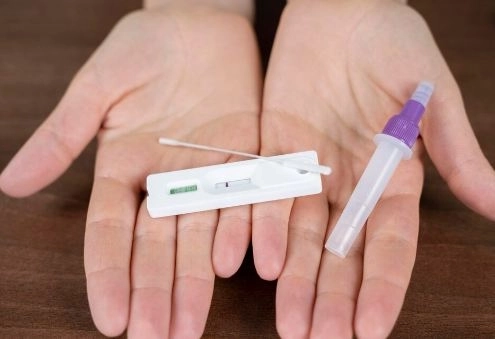
Home ovulation tests have become an essential tool for every wife or woman planning for pregnancy, as they help you identify your most fertile days accurately without the need for hospital visits or complicated procedures. Using this test, you can determine the best days for intercourse to increase the chances of conception and monitor hormonal changes in your body directly. In this Dalily Medical article, you will learn how to use a home ovulation test in detail, the optimal timing for taking it, its importance for women planning pregnancy, and tips to ensure accurate results and boost your chances of conception.
What is a Home Ovulation Test and How Does It Work?
A home ovulation test is a device used at home to track fertile days, usually in the form of urine test strips. How it works: it measures the level of luteinizing hormone (LH) in the urine.
When LH rises, it means the ovary is about to release an egg, and ovulation usually occurs within the next 12–36 hours. This is the best time for intercourse if the goal is conception.
How to Read a Home Ovulation Test Result:
No control line: the test is invalid; do not rely on the result.
Control line only: the test is valid, but the woman is not in her fertile period.
Control line + test line: LH surge detected → ovulation will occur in the next 34–36 hours.
How the Test Works:
The test captures urine on a strip or electronic device and measures the LH surge.
LH surge → ovulation within 24–48 hours.
This period is the optimal time for intercourse to increase chances of pregnancy.
When to Start Using a Home Ovulation Test:
For a 28-day cycle: start around day 10.
For shorter or longer cycles: calculate the start day according to your cycle length.
Daily testing is important to accurately detect the LH surge and achieve the best results.
Best Time of Day for Testing:
Use the test at the same time each day for accuracy.
Wait 4–6 hours after last urination to avoid diluted urine, which can reduce LH concentration.
Some digital devices allow testing anytime, but consistent timing gives more accurate results.
How Often to Test During the Cycle:
Typically 5–7 days depending on cycle length.
Daily testing helps pinpoint the exact day of the LH surge.
Accuracy of Home Ovulation Tests:
Most tests are 95–99% accurate in detecting LH surge.
Errors may occur due to:
Excessive fluid intake before testing
Certain hormonal or fertility medications
Not following instructions precisely
Difference Between Urine and Saliva Ovulation Tests:
Urine test: detects LH 24–48 hours before ovulation; most common.
Saliva test: detects microscopic crystal changes in saliva just before ovulation; less common.
Can You Rely on Ovulation Tests to Guarantee Pregnancy?
The test is a helpful tool to identify the most fertile days but does not guarantee conception.
Other fertility factors matter: timing of intercourse, egg quality, and partner’s health.
Using Ovulation Tests During Breastfeeding or After Miscarriage:
During breastfeeding: irregular cycles may reduce accuracy.
After miscarriage: wait until menstrual cycle returns to regularity before using the test.
Advantages of Home Ovulation Tests (OPK – Ovulation Predictor Kit):
Accurate Fertile Day Prediction:
Detects LH surge before ovulation
Identifies most fertile days 12–36 hours prior
Increases chances of pregnancy when intercourse is timed correctly
Faster and more precise than traditional methods (body temperature or cervical mucus)
Easy Home Use:
No blood tests or injections
Suitable for women of all ages
Digital versions display results clearly without interpreting lines
Fast Results:
Most tests give results within one minute
No need for lab visits or expensive tests
Daily Monitoring:
Can be used daily during fertile window
Tracks LH rise day by day
Detects changes in menstrual cycle
Reduces Guesswork:
Traditional signs (mucus, abdominal pain) can be misleading
Test provides clear measurable results
Suitable for All Cycle Types:
Regular or irregular cycles
Allows adjustment of test days for accurate predictions
Compatible with Digital Fertility Tracking:
Some tests connect to mobile apps to log results
Provides charts and reports of daily LH trends
Helps plan pregnancy or discuss fertility issues with a doctor
Convenient and Stress-Free:
Reduces anxiety about fertile days
Gives a sense of control over conception timing
Detects Hormonal Irregularities:
Can identify weak or repeated LH surges → indicates ovulation issues or PCOS
Helps consult a doctor timely
Lower Cost Compared to Medical Tests:
Cheaper than ultrasound or frequent blood tests
Easily available in pharmacies
Some digital tests are reusable
Types of Home Ovulation Tests:
Ovulation Test Strips:
Paper strip dipped in urine; result appears as a line
Easy and cheap for daily monitoring
Cons: line reading may be tricky, no digital alerts
Digital Ovulation Tests:
Displays results digitally or with smiley icons
Some connect to mobile apps
Cons: more expensive, requires new test for each use
App-Connected Digital Tests:
Stores and analyzes cycle patterns
Highlights fertile days, shares data with doctor
Cons: higher cost, requires app knowledge
Dual Hormone Strips:
Measures LH and estrogen
More accurate, detects peak fertility a day before ovulation
Cons: more expensive, slightly complex to use
Midstream Urine Tests:
Pee directly on stick without cup
Convenient for travel
Cons: similar to test strips, slightly costlier
Saliva Ovulation Tests:
Detects fine crystallization patterns in saliva before ovulation
Can be used anytime, travel-friendly
Cons: needs training to interpret, less common, higher cost
Tips for Using Home Ovulation Tests:
Test at the same time daily for accurate results
Avoid excessive water intake before testing
Record results to track cycles precisely
Start testing 2 days before expected ovulation for best chances
For irregular cycles, repeat tests over several cycles to identify patterns
Timing for Using Home Ovulation Tests:
OPK measures LH, which rises 1–2 days before ovulation
Cycle length: from first day of period to day before next period
Average cycle: 28–32 days
Adjust start day based on your actual cycle
Start Testing:
Regular 28-day cycle: start day 11, continue daily → ovulation usually day 14–16
Short 21–24 day cycle: start day 7–9
Long 31–35 day cycle: start day 15–17
General rule: start 4–5 days before expected ovulation to cover fertile window accurately
3️⃣ How Many Times to Test Daily
Most women: once per day is enough.
If your cycle is irregular: you can test twice daily (morning and evening).
Testing at the same time each day gives more accurate results.
4️⃣ Best Time of Day to Test
LH hormone usually rises in the morning, but shows clearly after about 24 hours.
Experts recommend testing in the afternoon or evening (12 PM–8 PM).
Avoid first morning urine as it may be too concentrated or inconsistent with LH levels.
5️⃣ Tips Before Testing
Limit water intake two hours before testing to avoid diluted urine.
Record your result daily with date and time.
When a strong LH surge appears → ovulation expected in 24–36 hours.
Try intercourse 2–3 days before ovulation to increase chances of pregnancy.
For irregular cycles: continue testing daily for 10–15 days from the start of your period.
6️⃣ After LH Surge Appears
The first day of LH surge → highest fertility day.
Continue testing the next day to confirm LH peak.
Ovulation usually occurs 12–36 hours after the LH surge → optimal time for conception.
7️⃣ Tips for Using a Home Ovulation Test
Choose the right type of test:
Quick strips: inexpensive and easy.
Digital devices: clear results without interpretation.
Advanced mobile-connected devices: precise tracking and data storage.
Ideal testing time: 12 PM–8 PM; avoid first morning urine.
Consistency: test at the same time daily for accurate results.
Cycle length and impact on testing:
Short cycle: start day 7–9
Regular cycle: start day 11
Long cycle: start day 15–17
Proper sample collection:
Collect urine in a clean, dry cup.
Dip strip for 5–10 seconds as instructed, then wait for result.
Recording and tracking results:
Record results daily with date and time.
Track trends over time rather than relying on a single test.
Additional tips:
Limit water intake two hours before testing.
Avoid caffeine or sugary drinks before testing.
Check any medications or supplements that might affect results.
Irregular cycles:
Test daily from day 7–10 until LH peak appears.
You may need to test more than once a day.
After LH surge:
Ovulation usually occurs 12–36 hours after LH peak.
Best days for intercourse: day of LH peak and the following day.
⚡ General tips:
Don’t rely on a single test; follow daily trends.
Store test strips/devices in a dry place, away from sunlight and moisture.
Consult a doctor if cycles are highly irregular or pregnancy does not occur after several cycles.
Monitor other fertility signs like clear cervical mucus or mild abdominal pain.
8️⃣ Accuracy of Home Ovulation Tests
What does accuracy mean?
Ability of the test to detect LH peak in urine accurately.
Predict ovulation within 12–36 hours.
Most tests provide 97–99% accuracy when used correctly.
Factors Affecting Accuracy
Test-related factors:
Type of test (strips are less accurate than digital devices)
Sensitivity of the strip to LH hormone
Expiration date or improper storage
Urine-related factors:
Diluted urine due to high water intake → false low results
Time of day: best between 12 PM–8 PM
Frequent urination reduces LH concentration
Body and hormone-related factors:
Irregular cycles, breastfeeding, previous pregnancy
Certain medications or supplements (Clomid, Letrozole, high-dose Vitamin C)
Ovulation disorders such as PCOS
Difference Between Detecting LH and Predicting Ovulation:
The test detects LH peak → hormone that precedes ovulation.
Actual fertility depends on the body’s response to LH; ovulation may sometimes be early or delayed.
Tips to Increase Accuracy:
Test at the same time each day.
Avoid fluids 2 hours before testing.
Use urine during 12 PM–8 PM.
Follow instructions carefully for dipping and waiting.
Track results daily: trend is more important than a single reading.
Digital devices are generally more accurate than traditional strips.
Accuracy in Special Cases:
PCOS: LH peak may be misleading → monitor other symptoms or use ultrasound.
Breastfeeding or previous pregnancy: hormonal changes → results may be unreliable.
Fertility medications: can cause multiple LH peaks → careful tracking is needed.
Limitations of Home Ovulation Tests and Usage Tips
1️⃣ Does not confirm ovulation:
Detects LH surge before ovulation but doesn’t guarantee egg release.
Women with PCOS may have LH rise without ovulation → false positive.
2️⃣ Possibility of false results:
Due to hormonal disorders, stress, medications, pregnancy, pituitary or adrenal conditions.
Can make a woman think she is fertile when she is not.
3️⃣ Does not measure other important hormones:
Focuses on LH only, not estrogen or progesterone, which are important for successful conception.
4️⃣ Difficult for very irregular cycles:
Determining test start day is harder for highly variable cycles.
May need several months of monitoring, which can increase stress.
5️⃣ Requires discipline and precision:
Test at the same time daily for accurate results.
Diluted urine or ignoring instructions reduces accuracy.
6️⃣ Some tests are sensitive to medications and supplements:
Fertility drugs like Clomiphene or hormonal supplements may affect results.
Misleading results without doctor guidance.
7️⃣ Does not indicate egg quality:
Even with accurate LH peak detection, test does not show if the egg is mature or healthy.
Pregnancy depends on egg and uterine health, not just ovulation timing.
8️⃣ Cost of repeated use:
Some digital or strip tests can be expensive if used daily.
Monitoring multiple cycles may cost more than medical tests.
9️⃣ Psychological stress:
Daily monitoring can cause anxiety or frustration if pregnancy does not occur immediately.
Some women obsess over results → disappointment if pregnancy is delayed.
???? Limited availability for continuous monitoring:
Traditional tests require monthly purchase of strips or bulk stock.
Advanced digital tests may need app subscription or charging.
Instructions for Using Home Ovulation Tests Correctly
Avoid highly concentrated first-morning urine → may give false results.
Use a sterile cup for urine collection to avoid contamination.
Keep the test strip vertical for accurate reading.
Follow the manufacturer’s instructions carefully; each test may vary slightly.
Wait 5–10 minutes before reading the result; do not rush.